Live Updates: Trump says he's deciding between deal or driving Iran "into hell with no chance of survival"
What to know about the Iran war today:
- President Trump told the U.N. General Assembly on Tuesday he has a "big decision to make" on whether to make a deal or drive Iran "into hell with no chance of survival and no hope of future greatness or generations."
- Iranian President Masoud Pezeshkian said Tuesday as he headed for the U.N. summit in New York that he would "firmly defend" Iran's positions in the war and use the opportunity to "convey Iran's plight."
- Reports that Iran is offering to reopen the Strait of Hormuz if the U.S. drops its naval blockade, and that a key Saudi oil pipeline damaged by drones is working again, appeared Tuesday to be keeping oil prices on a weeklong downward trend.
U.N. secretary-general says superpowers' "power isn't so super," calls for "world built on "interdependence"
U.N. Secretary-General Antonio Guterres pleaded for "a world built on interdependence" as he made his final address Tuesday to a yearly gathering of world leaders convening to face a formidable menu of challenges — from climate change and war to inequality and artificial intelligence.
The U.N. leader has long implored leaders not to give up on cooperation and shared decision-making in the face of accelerating global challenges and increasing great-powers competition.
Guterres also rebuked might-makes-right thinking, telling superpowers to recognize "that their power isn't so super." Recent years have made it clear that "military power alone cannot secure peace," he said.
Yet, about an hour after Guterres spoke, President Trump offered a different and equally frank view of power.
"While others have promised strength, I have used it to make America the most powerful country in the world," Trump said, touting his country's economic, technological and military footprint.
U.K. military to assist Saudi fight against Houthis with refueling aircraft
The U.K. is the latest country to come to Saudi Arabia's assistance in the country's fight against the Iran-backed Houthi militia in Yemen.
Air-to-air refueling aircraft will be provided by the U.K. "in support of the legitimate government of Yemen," according to the ministry of defense.
The Houthis have a longstanding feud with Saudi Arabia that was reignited in recent months following a four-year truce. The Houthis announced they would begin targeting Saudi-flagged oil tankers transiting the Bab el-Mandeb Strait out of the Red Sea in solidarity with Iran's blockade of the Strait of Hormuz.
Those widening strikes were followed by a military blitz last week, capturing new ground from government forces in western Yemen and taking control of the key coastal city of Mokha. The Houthis have also increasingly targeted energy infrastructure in Saudi Arabia.
"Saudi Arabia and Yemen are long-standing partners of the United Kingdom and play a vital role in regional stability," the ministry said in a statement. "It is in the UK's interest to protect regional stability, protecting vital trade and energy supplies and encouraging a diplomatic resolution to the conflict in Yemen."
The U.K. has already provided missile-defense systems for the Saudis, largely to prevent Iranian strikes, while the U.S. is a major backer of the Saudis. Also, Pakistan and Turkey recently signed a defense pact with Saudi Arabia that could lead to their involvement in the war.
Stocks climb as oil slides, AI buzz returns
Stock markets advanced Tuesday as oil prices fell further on speculation the United States and Iran could make progress on talks to end the Mideast war this week, with enthusiasm about Meta's new AI agent fanning a tech rally.
The Brent international crude benchmark was back below $100 a barrel, with investors eyeing a potential meeting between President Trump and Iranian President Masoud Pezeshkian at the U.N. General Assembly in New York.
Hopes that Saudi Arabia will quickly resume flows through its East-West pipeline added to the downward pressure.
That added to the positive mood from a renewed burst of confidence in artificial intelligence, which pushed technology stocks higher in Asia.
Wall Street indices opened higher after the Nasdaq hit an all-time closing high Monday, and stocks were broadly higher in Europe after rising in Asia.
Enthusiasm poured back into the technology sector after Facebook owner Meta's free AI agent Muse topped the download charts following its release this month.
"If there is widespread adoption of Muse, it could add to demand for other AI tools, which could lift the AI sector, after a rough few months," said Kathleen Brooks, research director at trading group XTB.
Meta said Muse, which can book travel, send emails and make purchases, was built for people with no technical background and is designed to work the way people already message each other.
Trump says deciding between deal or driving Iran "into hell"
President Trump told the United Nations General Assembly Tuesday that he had to choose whether to "annihilate" Iran if it fails to make a deal to end the Iran war.
"I have a big decision to make – will a deal be made with Iran that lets them rebuild and create a far greater country than it ever was before, maybe one of the greatest in the Middle East or even the world?" Mr. Trump said.
"Or do I annihilate the Islamic Republic and do it quickly, never giving them a chance to kill and destroy people and countries again?" he said. "Do I drive them into hell with no chance of survival and no hope of future greatness or generations?"
The president also reiterated that he believes an agreement is possible before U.S. midterm elections in November, in which his Republican Party faces losing control of Congress at least partly due to high fuel prices caused by the war.
"I believe we'll make a deal right after the election because it doesn't make sense for them not to," he said.
"They're waiting to see how I do in the midterm election. What they don't realize is that I'm not running. I did that already, and won in a landslide," he said.
Mr. Trump said Sunday he would "probably" meet on the sidelines of the U.N. summit with Iranian President Masoud Pezeshkian, who is attending along with the country's Foreign Minister Abbas Araghchi.
CBS/AFP
Putin and Saudi crown prince discuss conflict in Yemen
Russian President Vladimir Putin and Saudi Crown Prince Mohammed bin Salman discussed the deteriorating situation in Yemen and the wider Persian Gulf during a phone call on Tuesday, according to the Kremlin.
Putin stressed the need for political and diplomatic efforts to normalize the regional crisis, while both sides called for an early end to fighting in Yemen and the launch of constructive intra-Yemeni dialogue under United Nations supervision.
The Saudi-backed government of Yemen has since 2014 been locked in a civil war with Iranian-backed Houthi rebels. A fragile ceasefire that had held since 2022 was broken this summer as the war in Iran engulfed the region.
The two leaders also discussed the importance of safe and unhindered shipping through regional waterways, including the Bab al-Mandeb strait and the Strait of Hormuz.
Iran Air says it has not received any regional flight ban despite U.S. sanctions, says state news agency
Iran's national airline Iran Air on Tuesday said it had not been informed of any ban on services to neighboring countries, a day before the U.S. is due to tighten sanctions against the Iranian aviation sector.
"Iran Air has not received any notification or official instruction from the civil aviation authorities of Turkey, the Republic of Azerbaijan, or Iraq regarding a halt or suspension of the airline's flights to Istanbul, Baku, and Najaf," the company said in a statement carried by state news agency IRNA.
On Monday Treasury Secretary Scott Bessent told CNBC that as of Wednesday, "all the Iranian airlines will be shut down around the world."
"If they land, you cannot provide them with fuel, you cannot provide them with landing services, you cannot sell them tickets, or you will be knocked out of the dollar system," Bessent warned.
CBS/AFP
Iranian-backed Houthis say Saudi attack on Yemen prison killed 9 people
An attack by Saudi Arabia on a prison in northwest Yemen killed nine detainees, a Houthi official told the Saba news agency, which is affiliated with the Iran-backed rebel group, on Tuesday.
"Nine prisoners captured during recent events were killed last night when the Saudi enemy targeted a prison" in Al-Hazm, in Yemen's Al-Jawf governorate, Houthi official Abdelkader al-Murtada told the agency.
The conflict between the Iranian backed Houthi rebels and the Saudi-backed Yemeni government has escalated significantly in recent weeks, with the Houthis seizing strategic territory along the Red Sea coast, near the Bab el-Mandeb Strait.
President Trump had considered bombing Houthi positions in Yemen over the weekend, but decided against it late Saturday night, sources familiar with the discussions told CBS News on Monday.
China says it opposes "illegal" U.S. sanctions on Iranian airlines
China's government said Tuesday it opposed "illegal" U.S. sanctions on Iranian airlines, a day after Treasury Secretary Scott Bessent threatened potential measures in a televised interview.
"China consistently opposes illegal unilateral sanctions that lack a basis in international law or authorisation from the U.N. Security Council," foreign ministry spokesman Guo Jiakun said during a news conference.
The remark came ahead of a highly-anticipated meeting between President Trump and China's President Xi Jinping in Washington this Thursday.
CBS/AFP
U.S. open to meeting with Iranian officials at the U.N., says Rubio, but nothing scheduled
The U.S. is open to meeting with Iranian officials at the U.N. General Assembly in New York this week, Secretary of State Marco Rubio told NBC's "Today" show on Tuesday.
"We're open to that," he said. "I don't think anything is scheduled at this point, but we're certainly open to something like that, especially if it has the prospects of leading to something positive and ultimately achieving the goal of what this is all about."
President Trump told Fox News Sunday he would "probably" be willing to meet Iran's President Masoud Pezeshkian on the sidelines of the summit. Pezeshkian will attend the annual General Assembly along with Iran's Foreign Minister Abbas Araghchi.
Both men have said they will defend Iran's positions on the war during the summit.
Iranian official tells Reuters U.S. must make interest in peace deal "official," but indicates desire to "move forward"
"The U.S. needs to announce that it wants to resolve the issue diplomatically, make that official, and then agree on a timeline for how the process will move forward," a senior Iranian official told Reuters on Tuesday, corroborating a Japanese news agency's report that Tehran could reopen the Strait of Hormuz within a week if the U.S. steps back from military threats and lifts its blockade of Iranian ports and vessels.
The official told Reuters that Iran's delegation to the U.N. General Assembly, lead by President Masoud Pezeshkian, had been given authority by the Islamic Republic's supreme leader to revive diplomacy with the U.S., but they ruled out a meeting between Mr. Trump and his Iranian counterpart at U.N. headquarters in New York.
The Iranian official said the offer was presented to U.S. officials on Sept. 16., and that diplomatic efforts toward a peace deal could be revived this week via mediators, which have included Qatari, Pakistani and other regional officials.
Oil prices keep falling as reports say key Saudi pipeline back online, Iran offering Strait of Hormuz deal
Global oil prices continued their five-day descent Tuesday, with international benchmark Brent crude dropping back below $100 per barrel for the first time in two weeks amid reports of potential good news on the supply front.
The Reuters news agency cited three unnamed sources as saying Tuesday that Saudi Arabia had restarted operations at its crucial East-West Crude Oil Pipeline, which it said could see exports resume from its Red Sea port of Yanbu later in the day.
The sources said the pipeline, which was knocked out of service by drone attacks blamed on Iran-backed groups in Iraq early this month, was still only carrying a relatively low quantity of oil.
Officials previously said it could be out of service for as long as five weeks.
Saudi Arabia's state energy giant Aramco did not immediately confirm the Reuters report.
With the U.S.-Iran war severely restricting tanker traffic out of the Persian Gulf, Saudi Arabia has relied heavily on its East-West pipeline to get oil to the market by shipping it out of Yanbu and through the Red Sea.
Separately, Japanese state news agency Kyodo reported Tuesday that Iran was offering to reopen the Strait of Hormuz to commercial traffic within a week if the U.S. drops its naval blockade of Iranian ports and vessels.
There was no immediate confirmation of that offer as Iran's president and President Trump both headed for the U.N. General Assembly on Tuesday, where Mr. Trump has said he could be willing to meet with his Iranian counterpart.
Iran has "no trust" in the United Nations, foreign minister says
Iranian Foreign Minister Abbas Araghchi said Tuesday that Iran has "no trust" in the United Nations in its current form, with the country's President Masoud Pezeshkian en route to New York to attend the U.N.'s annual General Assembly.
Araghchi said that Pezeshkian would use his speech at the U.N. to "defend the legitimacy, rights and interests of the Iranian people," before decrying the lack of "serious condemnation" from "Western and European countries" of "the crimes that have been committed" in Gaza and the West Bank, Lebanon and Iran.
"Therefore, naturally, no trust remains in an organization that is influenced by these countries," he continued.
President Trump said Sunday that he would "probably" be willing to meet with Pezeshkian on the sidelines of the General Assembly.
Saudi authorities briefly warn of "potential danger" near Yemen border for 1st time since major Houthi attack
Saudi Arabia's civil defense agency issued a warning of potential danger in the country's south on Tuesday, the first alert since the Iran-backed Houthi rebels in Yemen launched an attack on Riyadh over the weekend.
"A warning has been issued by the National Early Warning Platform in the Najran Province to alert of a potential danger," read a statement posted online by the agency, which asked people to remain indoors and avoid open areas in the province that borders Yemen.
The alert was lifted a short while later.
CBS/AFP
Iran president vows to "firmly defend" country's positions at U.N. General Assembly in New York
Iran's President Masoud Pezeshkian on Tuesday vowed to "firmly defend" his country's positions as he departed for New York to attend the United Nations General Assembly.
"We emerged with our heads held high, and this is a source of dignity and pride for all of us. Therefore, we will firmly defend our positions in international forums," he said before flying out of Iran, according to video broadcast by Iranian state television.
Pezeshkian is due to speak at the U.N. meeting on Wednesday.
"We will make the best possible use of this opportunity to convey Iran's plight to the international community. We will firmly tell our adversaries that, despite all the unfairness and injustices, the Iranian people have stood their ground," he said.
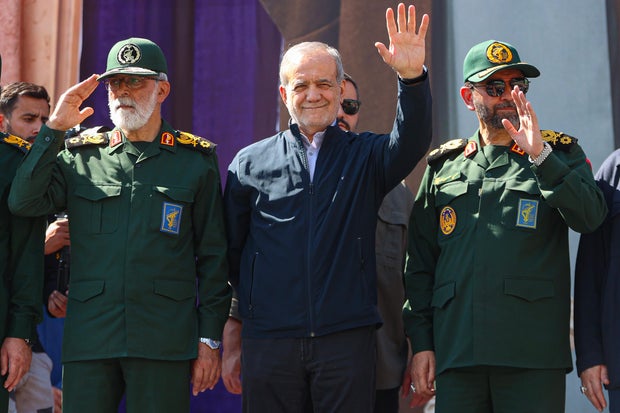
Pezeshkian will be the highest-ranking Iranian official to set foot on American soil since the start of the Middle East war, which began in late February with U.S.-Israeli strikes on Iran.
The United States has approved the U.N. visits for part of the Iranian delegation despite the war, but the group will be subject to movement restrictions, according to the State Department.
The Iranian president's communications team have not been authorized to travel, however, having been denied visas.
President Trump said Sunday that he would "probably" be willing to meet with Pezeshkian on the sidelines of the U.N. gathering, but no plans for such an encounter have been announced by either side.
CBS/AFP
U.K. to provide Saudi Arabia some military support to counter Houthi attacks
British Prime Minister Andy Burnham said Monday the United Kingdom has agreed to provide limited military support to Saudi Arabia to repel attacks by Iran-backed Houthi rebels in Yemen.
Burnham told reporters as he flew to the United Nations General Assembly in New York that he had agreed the Royal Air Force will provide air-to-air refueling of Saudi planes. The agreement is for a matter of weeks.
The conflict between the Houthis and Yemen's Saudi-backed government has reignited, with the Houthis aiming missile and drone strikes at Saudi Arabia, including one that targeted Riyadh on Saturday before being intercepted. The Houthis also declared a blockade on Saudi shipping in the Bab el-Mandeb Strait and the Red Sea, attacking Saudi-linked vessels and oil facilities inside the kingdom, one of the world's top oil exporters.
The Houthis advanced inside Yemen earlier this month, seizing the crucial port city of Mokha and key Red Sea islands, allowing them to better monitor shipping traffic through the Bab el-Mandeb, through which some 12% of world trade normally passes.
President Trump weighed striking the Houthis over the weekend after Saudi Arabia requested help, but late Saturday, he decided against ordering U.S. strikes, CBS News has previously reported.
Burnham said he was "acting to secure the interests of Britain and the wider region, because of course Saudi Arabia has been experiencing attack, is looking at potential further disruption, and we need to keep those pathways [for oil] open."
Britain has condemned the Houthi attacks and said the U.K. will "work with partners to support regional stability, protect civilians and support humanitarian access."
Houthi leader lashes out at Saudis in televised speech
The leader of the Iran-backed Houthi rebels in Yemen used the anniversary of his group's overthrow of the Yemeni government to lash out at Saudi Arabia.
In a pre-recorded speech aired Monday, Abdul Malik al-Houthi said his group's demands include an end to what he called Saudi "aggression" and the blockade the Saudi-led coalition has imposed on the rebels for about a decade.
"Stop the aggression and end the blockade. Our demands represent the legitimate rights of our people," he said in the speech aired by the Houthi-run al-Masirah channel.
The Houthis descended from their stronghold in northern Yemen, taking over the capital of Sanaa in September 2014 and forcing the country's government into exile in Saudi Arabia.
The following year, Saudi Arabia led a multinational coalition that entered the war in an attempt to restore the government. The coalition imposed an air and sea blockade on the Houthi-held areas, as part of its war efforts.
In war's opening days, Iran's attacks on Bahrain caught Navy families and sailors by surprise
On the very first day of the war, Iran targeted the Navy's Middle East headquarters in Bahrain — before the U.S. government had evacuated all the military families based there. Some had to wait about a week or more to reach safety, according to multiple families who spoke to CBS News.
"You're definitely scared," one military spouse said. "As the week goes on, you wake up to ballistic missiles being fired. We went to sleep with the sound of ballistic missiles again."
Iranian missiles and drones targeted Bahrain consistently for several days after the war began, according to another spouse. The scale and duration of those attacks appeared to take the U.S. government by surprise, three sources who were in Bahrain at the time told CBS News, in part because families hadn't been required to evacuate until the war had already begun.
The military had anticipated some retaliation and had even evacuated the headquarters' buildings on the base, but "we weren't expecting that [scale]," one U.S. official said. And there were still several military families living off the base nearby.
Iraq to suspend Iranian airlines sanctioned by the U.S., sources tell AFP news agency
Iraq will suspend flights by Iranian airlines after the U.S. Treasury chief warned that the sanctioned airlines would be "shut down" worldwide later this week.
Two Iraqi government sources confirmed the decision to AFP on Monday, with one saying that Baghdad would "enforce the ban on Iranian airlines in accordance with the U.S. Treasury decision starting Tuesday at dawn." The source warned that countries that do not implement the decision risk sanctions.
On Monday, U.S. Treasury Secretary Scott Bessent warned that Iranian airlines will have trouble functioning under the weight of American sanctions.
"If they land, you cannot provide them with fuel, you cannot provide them with landing services, you cannot sell them tickets or you will be knocked out of the dollar system," he told CNBC in an interview.
Iran's airspace was completely shut after the U.S. and Israel launched attacks in late February. Since then, some travel has resumed but only for flights run by Iranian carriers.
-CBS/AFP
2 tankers hit by "projectile" and debris in Hormuz, U.K. military maritime agency says
A maritime security agency said Monday that two tankers were hit either by an "unknown projectile" or debris from one in the Strait of Hormuz, where vessels have come under repeated fire since the Iran war broke out.
Iran is seeking to maintain a stranglehold on the vital waterway as leverage in its war with the United States, while Washington has imposed a counterblockade of Iranian ports, with both sides striking ships they accuse of noncompliance.
In the first incident reported on Monday, "a tanker conducting an inbound transit was struck by an unknown projectile" in the Hormuz, said the United Kingdom Maritime Trade Operations (UKMTO) operations center.
"Two crew have sustained minor injuries and the vessel is reported to be continuing to its next port of call under its own power," it added.
British security firm Vanguard Tech said U.K.-flagged tanker La Stephanie was hit by a drone while sailing towards the Gulf, also reporting minor injuries to two crew members.
Later in the day, UKMTO said an "LPG tanker has been hit by debris from unknown projectiles". No casualties were reported in the second incident and the tanker would also continue to its next port of call, it said.
-CBS/AFP
Yemen leader asked Trump for help against Houthis, source tells AFP news agency
The head of Yemen's Presidential Leadership Council held a call with President Trump in which he requested American support against the Iranian-backed Houthis, a source in his office told the AFP news agency on Monday.
The president did not promise military support, the source said, adding that the call took place on Sunday and was intended as a show of solidarity with Yemen's embattled government after the Houthis seized the country's entire Red Sea coast in a lightning offensive.
Mr. Trump weighed up striking Yemen's Iranian-backed Houthis over the weekend but ended up holding off late Saturday night, sources familiar with the discussions told CBS News on Monday.
-CBS/AFP
Houthi negotiating team meets U.N. envoy in Oman
Yemen's national negotiating delegation met with United Nations Special Envoy for Yemen Hans Grundberg in Oman's capital, Muscat, on Monday, the state-run Saba News Agency reported, citing an informed source.
The source said the delegation outlined Yemen's position on what it described as Saudi Arabia's "aggression" and the continued blockade of Houthi-controlled parts of Yemen, as well as Saudi military mobilization.
It also said the delegation attributed the current escalation to a Saudi strike on Sana'a International Airport on June 13.
According to the source, the delegation said Saudi Arabia had rejected ending restrictions on Yemeni airports and ports, lifting economic and humanitarian restrictions, and paying salaries—issues it described as the Yemeni people's demands before the United Nations.
President Trump considered striking Yemen's Iran-backed Houthis over the weekend
President Trump weighed up striking Yemen's Iranian-backed Houthis over the weekend but ended up holding off late Saturday night, sources familiar with the discussions told CBS News on Monday.
During Wednesday discussions with his national security advisers, the president indicated he was leaning against strikes. But after Saudi Crown Prince Mohammed bin Salman called on Thursday to again ask the president to assist, 10 days after he requested that Mr. Trump order strikes on the Houthis, Mr. Trump told the Pentagon to get ready for air strikes.
Late Saturday, however, the decision was made to hold off on U.S. action against the Houthis for now, the sources said, with the White House reluctant to expand the battlefield right now.
Reuters reported Monday that Mr. Trump spoke by phone with Rashad Al-Alimi, head of the Yemeni Presidential Leadership Council, the executive body of Yemen's internationally recognized government.
The Houthis have gained key strategic territory – particularly along the Red Sea coastline – from the Saudi-backed Yemeni government in recent weeks as the conflict has worsened.
Nearly 130,000 displaced in Yemen due to worsening conflict
Nearly 130,000 Yemenis have been displaced by the escalating conflict in Yemen, the United Nations' International Organization for Migration (IOM) said Monday.
According to the IOM, 129,438 people – from 21,573 households – have been displaced across seven regions in Yemen as the conflict between the Iranian-backed Houthi rebels and the Saudi-backed government escalates.
The IOM said the figure rose by 11,352 people in just three days, highlighting the rapidly worsening displacement crisis.
"These are families who have lost their homes and their income," said Othman Belbeisi, the IOM Regional Director for the Middle East and North Africa. "They are arriving in towns that were already struggling. Host communities are sharing the little they have, but they cannot do it alone. We need support now, for the people who have fled and for those who are taking them in."
As of Sept. 20, another 3,106 people had crossed the Red Sea from Yemen to Djibouti, according to the body.
U.S. stocks rise on hopes diplomacy shifts Iran war
Wall Street stocks rose early Monday as oil prices retreated amid optimism that this week's diplomatic events could alter the course of the Iran war.
This week's United Nations gathering will bring President Trump and Iranian President Masoud Pezeshkian to New York City, meaning the market is "resting some additional hope" on the possibility of a meeting between the men, said Briefing.com analyst Patrick O'Hare.
The president said Sunday he would "probably" meet Pezeshkian.
Mr. Trump is also slated to meet with Chinese President Xi Jinping at a summit later in the week, an engagement that could also touch on ways to lessen the U.S.-Iran war's impact on oil supply.
About 15 minutes into trading, the Dow Jones Industrial Average was up 0.2% at 51,768.81.
The broad-based S&P 500 gained 0.6% to 7,698.74, while the tech-rich Nasdaq Composite Index jumped 1.1% to 26,804.02.
A dip in U.S. Treasury bond yields also supported equities.
Lower crude prices and bond yields "seem to be a tailwind for markets, but this also means that if you are realistic to those factors, this could reverse at any point," said Art Hogan of B. Riley Wealth Management.
CBS/AFP
U.S. Treasury chief says Iran airlines to be "shut down" on Wednesday
U.S. Treasury Secretary Scott Bessent warned Monday that Iranian airlines will have trouble functioning globally in two days under the weight of American sanctions - as the Trump administration seeks to keep pressure on Tehran.
On Sept. 23, "all the Iranian airlines will be shut down around the world," Bessent told CNBC in an interview.
"If they land, you cannot provide them with fuel, you cannot provide them with landing services, you cannot sell them tickets or you will be knocked out of the dollar system," he added.
Pakistan's interior minister arrives in Iran for high-level meetings
Pakistan's Interior Minister, Senator Syed Mohsin Raza Naqvi, arrived in Tehran Monday to meet with senior Iranian officials, Iran's IRNA state news agency reported.
Iranian Foreign Ministry spokesman Esmaeil Baqaei said earlier that Iran and Pakistan had maintained "very good and growing" relations, with ties improving across various areas in recent months. He said the visit was taking place within the framework of bilateral discussions.
Baqaei rejected speculation that Naqvi was carrying a special message or proposal from the United States, saying the main purpose of the visit was to follow up on previous agreements between Tehran and Islamabad.
Pakistan, like Qatar, has acted as a mediator throughout the Iran war, liaising between U.S. and Iranian officials.
Naqvi has visited Tehran several times in recent months. During his latest visit, he met with Iranian President Masoud Pezeshkian, Foreign Minister Abbas Araghchi and other senior officials.
Oil prices continue to tick downward on apparent hopes for a return to diplomacy
Oil prices fell more than 3% Monday as tanker traffic and energy flows through the Strait of Hormuz picked up, although the strait has remained largely closed and uncertainty persists over the future of U.S.-Iran diplomacy.
President Trump said Sunday he would "probably" be willing to meet Iranian President Masoud Pezeshkian on the sidelines of this week's United Nations General Assembly, but Pezeshkian's communications team have been refused visas, Iranian state media reported Monday.
Tension between Saudi Arabia and the Iranian-backed Houthis, and Saudi Arabia's closure of a key oil pipeline that was hit by drones more than a week ago, also continue to add pressure to global oil supplies.
Brent crude, the international standard, fell more than 3% to less than $100.00 per barrel on Monday, however. It was trading at roughly $72 a barrel in late February, before the start of the war in Iran.
CBS/AP
Tanker struck by unknown projectile in Strait of Hormuz, U.K. military agency says
A tanker transiting the Strait of Hormuz was struck by an unknown projectile Monday, a British navy agency said, with two crew members reportedly sustaining minor injuries.
The incident took place late Monday morning local time according to the U.K. Navy's Maritime Trade Operations center (UKMTO), which cited unspecified military authorities.
"The vessel is reported to be continuing to its next port of call under its own power," UKMTO said in its bulletin, which was posted to X.
No one immediately claimed responsibility for the incident, which authorities were investigating, according to the agency.
U.S. refuses visas for Iran president to bring his communications team, says Iranian state media
The United States has refused to issue visas for Iranian President Masoud Pezeshkian's communications team, ruling them out of this week's trip to the U.N. General Assembly, Iranian state media reported Monday.
"In an unprecedented hostile move by the U.S. government, Mr. Trump has denied U.S. visas to certain members of the president's high-level delegation," state news agency IRNA reported. The Mehr news agency also carried the story, citing a spokesperson for the Iranian presidency.
Mr. Trump told Fox News on Sunday that he was "probably" open to meeting with Pezeshkian on the sidelines of the summit this week.
CBS/AFP
Iran's Revolutionary Guard says the country is prepared for long-term war
Iran's paramilitary Revolutionary Guard Corps "has prepared itself for a long-term war" and is now "more prepared than before," spokesman Hossein Mohebbi said on Sunday, according to the country's semi-official Mehr News.
Mohebbi described what he called a "historical and disgraceful defeat" for the United States, arguing that Washington has suffered strategic setbacks in several areas, including its failure to reopen the Strait of Hormuz, the vulnerability of its regional military bases and intelligence facilities, and the performance of U.S. military technology against Iran's capabilities.
He said the U.S. had also suffered a loss of regional influence, claiming that "America has not lost a war; America has lost a system."
Mohebbi said Iran, on the other hand, was now helping to determine a new emerging security order for the region.
"The war continues, and the Islamic Revolutionary Guard Corps has prepared itself for a long-term war," he said. "It was ready before, and now it is even more prepared for a long-term war."
Iranian president to depart for U.N. General Assembly on Tuesday
Iranian President Masoud Pezeshkian will leave Tehran on Tuesday to attend the United Nations General Assembly in New York, Iran's semi-official Mehr News reported Monday.
Pezeshkian is expected to address the summit and hold meetings with several other national leaders on the sidelines of the event, the outlet reported.
President Trump told Fox News on Sunday that he was "probably" open to the idea of meeting with Pezeshkian this week.
Iran warns it will expand the war if there is another U.S. assault
Iran's powerful Islamic Revolutionary Guard Corps warned Sunday that any new U.S. assault would be met with an expansion of the already-complex regional conflict to new areas.
"If a new aggression occurs, we will certainly change the weaponry and the geography of the war," IRGC spokesman Hossein Mohebbi said Sunday according to the country's semi-official Fars news agency.
Mohebbi added that Tehran was prepared for the nearly seven-month war to drag on.
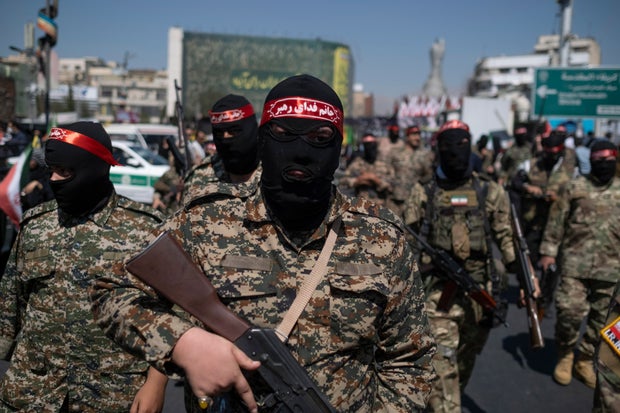
The statement came after President Trump reiterated on Sunday that he was poised to make a decision on whether to re-intensify U.S. attacks on Iran that he previously said could "annihilate" the country's Islamic Republic regime, or to seek a new diplomatic agreement to end the war.
Mr. Trump told Fox News he was "probably" open to the idea of meeting with Iranian President Masoud Pezeshkian this week on the sidelines of the United Nations General Assembly in New York.
Trump says he's in "deciding mode" on Iran
President Trump told Fox News that he's in a "deciding mode" on Iran, forecasting "very big things" to come in the near future as he considers his options in the war.
Fox News' Trey Yingst said he spoke with the president, who said he's considering a handful of choices, including "wiping Iran out," "letting them rot economically," or striking a deal.
"My question is, if and when do I blow the entire nation up? They better behave," the president told Yingst.
Yingst said the president also told him he'd probably be open to meeting with Iranian President Masoud Pezeshkian, who is expected to attend the United Nations General Assembly in New York this week.
The comments come after Mr. Trump told Axios on Thursday that he's facing a "big decision" on whether to "annihilate" the Iranian regime.
CIA director meets with Egypt's Sisi amid U.S. warning of "potential" Middle East escalation
CIA Director John Ratcliffe met with Egyptian President Abdel Fattah al-Sisi during a rare visit to Cairo on Sunday.
Sisi's office said the meeting, attended by Egypt's spy chief Hassan Rashad, included discussion of the wars in Iran, the Gaza Strip and Sudan, as well as attacks on Gulf countries and threats to maritime security.
Sisi stressed "the paramount importance of settling regional crises through political and diplomatic tracks," according to a presidency statement.
On Saturday, the U.S. State Department warned Americans against traveling to the region as hostilities rage between Saudi Arabia and Yemen's Houthis.
Ratcliffe's visit also came days after de facto Saudi leader Crown Prince Mohammed bin Salman met Sisi in Cairo. The pair urged safe and secure maritime navigation through the Bab el-Mandeb Strait, after the Iran-backed Houthis seized the Yemeni coast along the vital waterway in a lightning offensive.
Cairo is a key U.S. ally in the region and one of the top recipients of U.S. military aid. It has repeatedly positioned itself as a stabilizing force in a turbulent region, keeping open lines of communication with rival sides, including Israel, Hamas and Iran.
Sisi's office said Ratcliffe "lauded Egypt's pivotal role in supporting efforts aimed at reaching peaceful, comprehensive settlements to regional crises."
CBS/AFP
Tehran has conveyed conditions to U.S. for reopening of Strait of Hormuz, Iran's top negotiator says
Iran has conveyed to Washington through mediators its conditions for reopening the strategic Strait of Hormuz, which it has blockaded throughout the Middle East war, Tehran's top negotiator said Sunday.
The two foes are locked in a stalemate months into the conflict, particularly over the Strait of Hormuz, a vital shipping route for the world's oil and gas.
"Our messages and the explanation of our conditions have been clearly conveyed to the other party through mediators," said Iranian parliament speaker Mohammad Bagher Ghalibaf, who has acted as chief negotiator in talks to end the war.
"As long as the conditions are not met ... and the U.S. commitments are not honored, it will be impossible to return to the situation from before the negotiations and to an open strait," he added, according to state television.
Mohsen Rezaei, the head of Iran's supreme national security council, said on Saturday that the Islamic Republic had conveyed its conditions to the U.S. via mediator Qatar.
"Our conditions are an end to the war on all fronts, the release of our frozen funds and an end to the naval blockade," he said in an interview with Al Jazeera.
CBS/AFP
Egypt, Jordan and Kuwait condemn Houthi attack in Riyadh
Three Muslim and Arab countries condemned the Houthis' attack in Riyadh, saying it was a threat to regional security and stability and a violation of international law.
Egypt, Jordan and Kuwait, in separate statements, said their governments stand with Saudi Arabia in support of its sovereignty and protection of its civilians.
The Muslim World League also condemned the attack on civilians and civilian infrastructure as a violation of "all religious values as well as international and humanitarian laws and norms."
It was the first time the Saudi capital has been targeted since the escalation in fighting with the Iran-backed rebels opened a new front in the Iran war. Saudi Arabia said the attack was intercepted. Some residents in Riyadh heard an explosion, and later some saw a plume of smoke near the airport. There were no reports of casualties or damage.
In recent weeks, fighting has intensified between Saudi Arabia and the Houthis, who have taken control of vast swaths of Yemen's Red Sea coastline, along with several islands in the critical Bab el-Mandeb Strait, a move which has put more pressure on an already stressed global oil supply.
CBS/AP
U.S. embassies across Mideast issue security alerts amid "potential for unforeseen escalation"
U.S. embassies across the Middle East early Sunday morning local time issued security alerts for American citizens in the region.
"Due to tensions in the Middle East, the security environment remains complex with the potential for unforeseen escalation," said the alerts issued by embassies in Israel, Saudi Arabia, Iraq, Kuwait, Lebanon, Jordan, Bahrain, the United Arab Emirates and Qatar.
The alerts did not state a specific threat, but called for Americans to "exercise heightened vigilance and be aware of potential flight cancellations, airspace closures, and travel disruptions."
They cited the recent fighting between Saudi Arabia and the Iranian-backed Houthi militants in Yemen, noting that the conflict between the two sides "has the potential to escalate rapidly."
Turki al-Malki, a spokesperson for the Saudi coalition fighting the Houthis, said in an earlier statement posted on X that Saudi forces had intercepted a ballistic missile fired at the capital city Riyadh on Saturday.
In recent weeks, fighting has intensified between Saudi Arabia and the Houthis, who have taken control of vast swaths of Yemen's Red Sea coastline, along with several islands in the critical Bab el-Mandeb Strait, a move which has put more pressure on an already stressed global oil supply.
Saudi Arabia's crucial East-West oil pipeline was damaged by drone strikes earlier this month believed to have been conducted by Iran-backed militias operating in Iraq, although no group has taken credit for the attacks.
The Houthis have attempted a blockade on Saudi ports since July.